
What if your booking system is organised, but you’re still unsure why you hold a student’s injury notes or who can see a signed waiver? GDPR compliance for UK yoga studios starts with knowing what personal information you collect, why you need it and who handles it. Software can organise bookings an...

What if your booking system is organised, but you’re still unsure why you hold a student’s injury notes or who can see a signed waiver? GDPR compliance for UK yoga studios starts with knowing what personal information you collect, why you need it and who handles it. Software can organise bookings and member records, but your studio still decides what to collect and how to use it.
Health details, waivers, lawful bases and marketing consent can feel like a tangle when you’re also managing classes and members. You don’t need to become a data protection specialist to make sensible decisions. Clear, practical steps can make your responsibilities easier to manage.
This checklist will help you map the information your studio holds and review your privacy notices, security, retention and process for handling individual requests. It also covers the published complaints procedure required since 19 June 2026, and what to consider when reviewing booking tools and provider responsibilities. By the end, you’ll have a clearer way to handle member information and identify useful next steps for your studio.
• Make GDPR compliance for UK yoga studios manageable by mapping what student information you hold, where it lives and why you use it.
• Trace the student journey from first enquiry to deletion to spot where personal details enter your studio’s records.
• Choose a lawful basis for each data use. Consent isn’t automatically the right fit for every booking or operational message.
• Build a practical routine for clear privacy information, accurate records, access controls, retention reviews and individual requests.
• Assess booking software as one part of your approach, paying attention to access, data handling, retention, deletion and your own responsibilities.
Student details don’t stop being personal data because they’re written on paper or saved in a spreadsheet. If your studio handles information that identifies a student, data protection rules are part of everyday work, from taking bookings to keeping records and communicating with members. GDPR compliance for UK yoga studios starts with treating these ordinary tasks as data handling, not just admin.
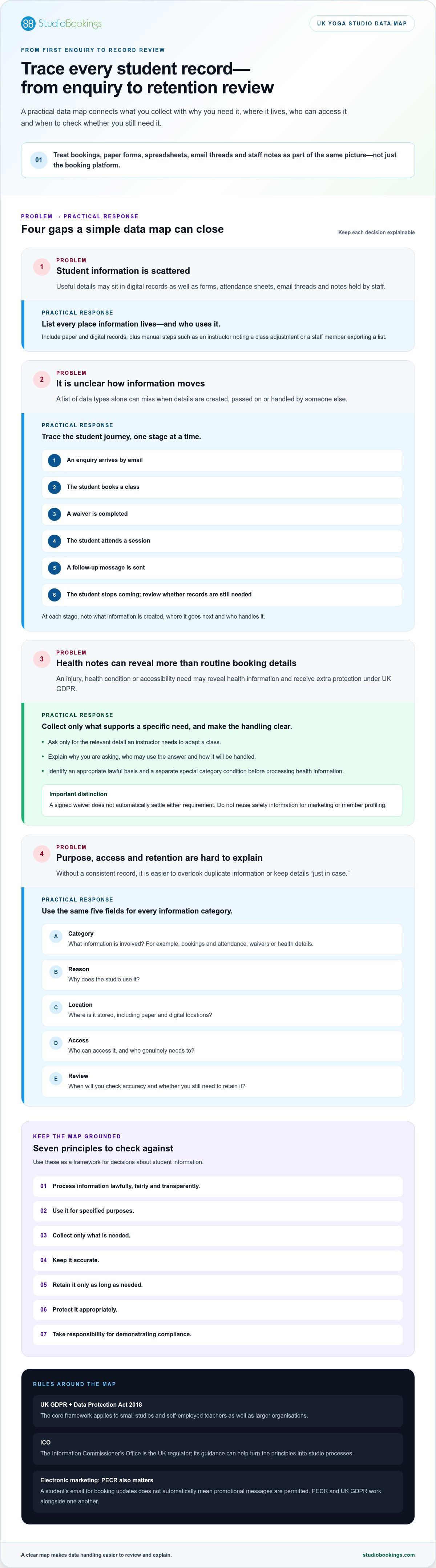
UK data protection law is built around the UK GDPR and the Data Protection Act 2018, as amended by later legislation. The rules apply to organisations of all sizes, including small studios and self-employed teachers. The seven data protection principles offer a useful framework: process information lawfully, fairly and transparently; use it for specified purposes; collect only what’s needed; keep it accurate; retain it only as long as needed; protect it appropriately; and take responsibility for demonstrating compliance. These principles guide decisions, but don’t make them for you.
Personal data is information relating to an identified or identifiable living person. Someone may be identifiable directly, such as by name, or indirectly by combining details. Names, email addresses, phone numbers, class bookings and payment records can all identify a student. Online identifiers may count too when they can be linked to a person. For a wider overview of the underlying framework, see Understanding the General Data Protection Regulation (GDPR).
Some information needs extra care. A note about a student’s injury, health condition or accessibility needs may reveal health information, which is special category data under UK GDPR and has additional requirements. It’s different from routine contact or booking details. Consider whether you need to collect it, who genuinely needs access and how you’ll protect it. A waiver can contain ordinary personal information, health details or both.
Look beyond your booking platform. Forms in a filing cabinet, attendance sheets, email threads and staff-held notes all deserve attention. Paper records are within scope when kept in a relevant structured filing system, just as digital records can be. Start by noting where each type of information lives and who uses it.
The UK GDPR sets core rules for handling personal data, while the Data Protection Act 2018 supplements the framework and covers related provisions. The Data (Use and Access) Act 2025 amended UK data protection law, with most changes taking effect on 5 February 2026. The Information Commissioner’s Office (ICO) is the UK regulator. Its guidance can help you turn the principles into studio processes.
Electronic marketing also brings in the Privacy and Electronic Communications Regulations (PECR). PECR and UK GDPR work alongside one another; they aren’t interchangeable. For example, an email campaign may involve personal data under UK GDPR and electronic marketing rules under PECR. Collecting a student’s email for booking updates doesn’t automatically answer whether you can send promotional messages.
You don’t need a complex compliance programme to make a meaningful start. An information inventory, sensible access routines and regular reviews give a small studio a manageable foundation. The key is to make deliberate choices and be able to explain them.
A useful data map shows more than what you collect. It connects each item to a purpose, the people who can access it, where it’s stored and when you’ll review whether you still need it. That makes decisions about collection and use easier to explain, and helps you spot duplicate records or information gathered “just in case.”
Follow a student’s journey through your studio: an enquiry arrives by email, the student books a class, completes a waiver, attends, receives a follow-up message and eventually stops coming. At each point, note what information is created, where it goes next and who handles it. Include manual steps too, such as an instructor writing down a class adjustment or a staff member exporting a list.
Information about a person’s health, including an injury, can be special category data under UK GDPR when it reveals their physical or mental health. Processing it generally requires both an appropriate lawful basis and a separate special category condition. A signed waiver doesn’t automatically settle either question. Identify the purpose and check the applicable requirements before collecting or using the information.
Keep the purpose specific. If an instructor needs a relevant detail to adapt a class, ask only for what supports that need. Avoid open-ended questions that invite unrelated medical history, and don’t reuse safety information for marketing or member profiling. Explain why you’re asking, who may use the answer and how it will be handled.
Start with a simple table or document. For each category, record the reason for using it, its location, who can access it and a date to review accuracy and retention. The ICO’s Official UK GDPR Guidance from the ICO can help you check your approach against current guidance.
Identify the booking records, class lists and attendance notes used to run sessions.
Record paper and digital copies, their purpose and which staff need access.
Note where messages, contact details and payment information are held, including relevant external systems.
Include notebooks, printed lists, emails and personal files used for studio work.
Apply purpose limitation and data minimisation together. Keep information that supports a clear studio need, but don’t collect extra details merely because a form has room for them. Set a review date for each category so someone checks whether it’s still accurate and necessary, rather than letting records accumulate indefinitely. The ICO’s UK GDPR guidance is a useful reference as you shape those routines.
A booking platform can organise bookings and member records, while your data map clarifies the purposes and access rules around them. If you’re refining that workflow, explore yoga studio management software as one practical part of your setup.
Once you know what information your studio uses, decide why each use is necessary and identify its lawful basis under UK GDPR. The right basis depends on the purpose and circumstances, not simply on which option seems easiest. Consent isn’t automatically required for every booking, record or operational message. The UK Government Data Protection Overview explains the UK framework and individual rights, while the ICO’s guidance can help you assess specific scenarios.
Separate activities that may look similar but serve different purposes. For each one, ask what you’re doing, why it’s needed and which basis fits that actual use. For example:
Is using the student’s details objectively necessary to arrange and manage a class booking or membership agreement?
Are you required by law to keep a particular record, and for how long?
Does the proposed basis fit the channel and circumstances? Consent and legitimate interests may be relevant in some cases, but electronic marketing must also comply with PECR.
What specific purpose justifies using these details, and which Article 9 special category condition applies in addition to an Article 6 lawful basis?
Health information needs both tests. A lawful basis by itself doesn’t meet the additional UK GDPR requirements for special category data. Don’t treat a signed form as an automatic answer. Document your reasoning and check current ICO guidance for the particular activity. The same discipline helps you avoid using one basis to cover unrelated purposes.
A controller decides why personal data is processed and the essential means of doing it. A processor handles data on a controller’s behalf and under its instructions, but the roles depend on the parties’ actual decisions and arrangements. A software provider may process student records for the studio, while the studio remains responsible for its own purposes, lawful bases, privacy information and decisions about what to collect.
Using booking software doesn’t transfer every studio responsibility to the provider. The software can organise bookings and member records, but it can’t decide whether your purposes are lawful or make the studio compliant by itself. Review the processing terms and relevant information about security, subprocessors, retention and deletion. Make sure your own privacy information accurately describes how the tool fits into your data flows.
As you compare tools, consider how their workflows fit your decisions about access and handling. This guide to yoga studio software for small studios can support that review. Good GDPR compliance for UK yoga studios comes from matching each purpose to a basis and keeping responsibilities clear across the studio and its providers.
Turn your data map into a routine. Work through these steps in order, then revisit them when your studio’s services, systems or staff change. A simple process that people can follow is more useful than a policy nobody uses.
List the student and staff data your studio holds, its purpose, where it’s stored and who can access it. Include paper forms, inboxes, spreadsheets and booking tools. This gives you a practical starting point for GDPR compliance for UK yoga studios.
Publish privacy information that says what you collect, why you use it, the lawful basis for each purpose, how long you expect to keep it and how people can contact you. Make it easy to find when someone gives you their details, and update it when your practices change. Keep promotional messages distinct from class administration. Before sending electronic marketing, check the relevant PECR rules for the message and channel. A booking email isn’t automatically permission to send promotions.
Give staff access appropriate to their role, rather than letting everyone see every record. Use individual accounts and permissions where available, and remove access when someone no longer needs it. Avoid shared passwords because they make it harder to know who accessed information and to limit access appropriately.
Set dates to check records for accuracy and confirm whether you still need them for the purpose you documented. Don’t keep information indefinitely by default. When the purpose ends and no other obligation requires the record, arrange deletion or secure disposal, including copies in paper files and exports. Keep a note of your retention decisions so the routine is repeatable.
Decide who receives requests from students and how staff should pass them on. Be ready to locate information, correct inaccuracies and handle rights requests; the usual response period for an individual request is one month. Publish a data protection complaints process, acknowledge complaints within 30 days and record how you addressed them. If information may have been exposed, log what happened, limit further access, assess the risk to people and check reporting duties promptly. Report a breach to the ICO without undue delay and, where feasible, within 72 hours if it’s likely to pose a risk to individuals.
Keep the checklist somewhere staff can use it, and assign an owner to each routine. Practical yoga business software guidance can help you think through how tools fit into your workflows. If you’re ready to organise bookings and member records, explore yoga studio software as one part of your approach, alongside clear studio policies and decisions.
Booking software can bring bookings, waivers and member records into a more organised workflow. But using a platform doesn’t transfer every data protection responsibility to its provider, and no tool by itself proves your studio is compliant. You still decide what information to collect, why you need it, who should access it and how long to retain it.
Use your data map to assess the system in context. Trace information from a student’s first booking through class attendance, follow-up and eventual deletion. Then check whether the software’s features and arrangements support the processes you’ve chosen. The aim isn’t to tick a “compliant software” box. It’s to understand how the tool fits into your studio’s responsibilities. For organisations curious about how digital platforms evaluate user experience and visual attention during sign-up workflows, ergoneers.com provides an overview of eye-tracking technology and behavioral research.
Before adopting or configuring a platform, consider each area below. Record the answers with your wider data map so staff know what to do:
Identify which details enter the system, why each is needed and whether health details or other sensitive information are involved.
Check which roles can see or manage each type of record. Give staff only the access needed for their work, and avoid shared credentials that could expose more information than intended.
Review the processing terms and documented information about how the provider handles data, including any subprocessors, retention and deletion arrangements. Reflect the actual arrangement in your own privacy information.
Plan how you’ll find, correct or otherwise respond to information in the platform, and how that fits with records held elsewhere. Set a process for retention reviews and deletion across the complete student record, not just one system.
These checks matter because booking software is only one part of the picture. Paper waivers, staff notes, emails and payment records may sit outside the platform and still need to be covered by your studio’s procedures. A clear view of those boundaries makes GDPR compliance for UK yoga studios more practical to manage.
StudioBookings provides online bookings and waivers, member profiles, separate logins for owners, staff and clients, and staff permissions. These features help organise routine studio activity. Only the studio owner has access to all studio data. If the owner shares the password, others can access it, so use separate logins and staff permissions to manage access appropriately.
StudioBookings does not share personal information. If you cancel or do not convert after the free trial, all studio and member information is deleted. Include this lifecycle in your records and retention planning, and consider how it relates to any copies you keep elsewhere. Your studio remains responsible for its data protection decisions, including information held outside the platform.
Once you’ve completed your own checklist and reviewed how a booking tool fits your processes, explore StudioBookings for your yoga studio.
GDPR compliance for UK yoga studios isn’t a one-off task to file away. Make it part of how your studio works: revisit your data practices when you add a class, change a booking process or bring someone new onto the team. A short, regular review can help keep your approach aligned with the way your studio actually operates.
Choose someone to own that review and make sure staff know how to raise a question or flag a concern. The goal isn’t to create more admin. It’s to build thoughtful data habits into the experience you offer students, so care continues beyond the mat.
If you’re ready to make everyday studio management more organised, take a look at the tools available and decide how they fit your approach. Explore StudioBookings for your yoga studio, and take your next step with confidence.
Yes. GDPR compliance for UK yoga studios matters even if you teach alone or run a small timetable, because the rules can apply when you handle information about identifiable people. A name beside a class booking, an email enquiry or a staff note linked to a student may all be relevant. List the places you keep records, including instructors’ work folders, and revisit the list when you introduce a new form or system.
It can be. A student’s injury or health condition may reveal information about their physical or mental health, so treat it with particular care. For example, if you need to know whether a student needs a class modification, consider whether a brief functional note would serve the purpose instead of asking for a full medical history. Before using health information, identify both the appropriate lawful basis and a relevant special category condition for your specific process.
No. The appropriate lawful basis depends on the purpose, so don’t treat one consent checkbox as permission for every activity. A student’s booking details and their choice to receive promotional messages, for example, serve different purposes and should be considered separately. If you later want to use information for a new purpose, assess that use before proceeding. Keep a record of your reasoning and check whether electronic marketing rules also apply.
No. Software may help keep class and membership workflows organised, but it can’t decide whether your studio’s reasons for using information are appropriate. It also won’t automatically cover records kept in an instructor’s notebook, an email inbox or a separate payment system. Treat the platform as one part of your process: decide who should use it, explain its role to students and account for every other place their information is held.
Explain in clear language what information you collect, why you use it, the lawful basis, how long you keep it and how students can exercise their rights. Identify relevant recipients or providers where required, and give a contact route for questions. Put the notice where students can find it as they provide information, such as alongside an online enquiry or booking form. Review it whenever your studio’s actual practices change.
There isn’t one retention period for every record. A payment record, an attendance history and an old health form may serve different purposes and may be subject to different obligations. Decide what applies to each category, document the reason and set a review point. For example, when a membership ends, assess whether each record is still needed rather than keeping the entire member file indefinitely by default.
Possibly, but promotional emails involve data protection and electronic marketing rules, including PECR. A student giving an email address to receive a booking confirmation doesn’t automatically mean they want studio offers. Keep promotional preferences distinct from essential class messages, and make sure your process reflects the rules for your audience and circumstances. Record preference changes so the people sending emails can act on them, and check current ICO guidance before launching a campaign.