
The global yoga market is projected to grow from $63.82 billion in 2025 to $119.69 billion by 2034, but market growth alone won’t make a studio viable. To learn how to create a yoga studio business plan for 2026, start with local demand, set out the core business-plan sections, then build cash-flow...

The global yoga market is projected to grow from $63.82 billion in 2025 to $119.69 billion by 2034, but market growth alone won’t make a studio viable. To learn how to create a yoga studio business plan for 2026, start with local demand, set out the core business-plan sections, then build cash-flow and break-even projections around your likely revenue and costs.
It’s natural to see opportunity in yoga and still feel unsure about the numbers, competition, or what belongs in a business plan. A practical plan turns those questions into decisions you can act on, from who your classes are for to how you’ll cover expenses as membership grows.
This guide shows you how to assess your local market, build each part of the plan, and map startup cash flow and break-even. You’ll have a framework for testing whether your studio idea is viable and updating your plan as operating data comes in.
• Assess local demand by looking at prospective members’ needs, class preferences, and willingness to book and attend.
• Build your plan as a practical roadmap, connecting your studio vision to services, staffing, marketing, and measurable goals.
• Compare class formats and revenue streams to shape an offer that fits your audience and capacity.
• Map startup costs, ongoing expenses, and expected cash timing to see how your studio could reach break-even.
• Write the executive summary last, once your research, operating plan, and financial projections are in place.
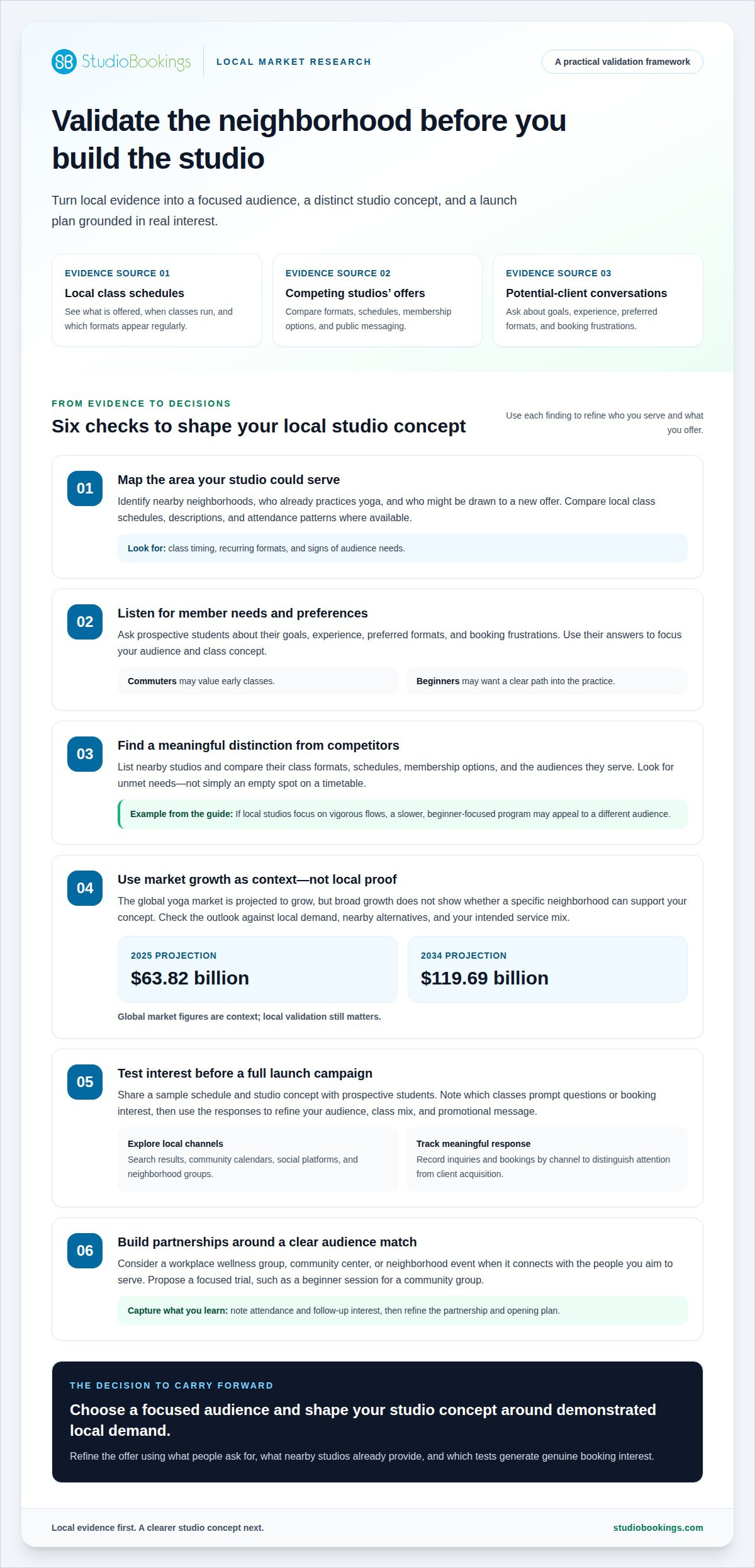
Start with three sources of evidence: local class schedules, competing studios’ offers, and conversations with potential clients. Use what you learn to choose a focused audience and shape a studio concept around demonstrated demand.
•
Map the neighborhoods your physical studio could serve, then identify who already practices yoga and what might attract new clients. Compare local schedules, class descriptions, and attendance patterns where available. Ask potential students about their goals, experience, preferred formats, and booking frustrations. Commuters, for example, may value early classes, while beginners may want a clear path into the practice.
•
List nearby studios and compare their formats, schedules, membership options, and public messaging. Note which classes appear regularly and which audiences each studio serves. Look for unmet needs, not just gaps in a competitor’s timetable. If local studios focus on vigorous flows, a slower, beginner-focused program may appeal to a different audience. Build your positioning around a meaningful distinction.
•
Use broad market growth as context, not proof that your neighborhood can support another studio. The global yoga market is projected to grow from $63.82 billion in 2025 to $119.69 billion by 2034. Test that outlook against local demand, nearby alternatives, and your intended service mix. A growing market can still contain neighborhoods where the audience or concept needs refinement.
• Choose marketing channels your target members already use. Review local search results, community calendars, social platforms, and neighborhood groups to see where yoga events are promoted. Match each channel to a specific action, such as advertising an introductory class in a community newsletter. Track inquiries and bookings by channel to distinguish attention from actual client acquisition.
• Test demand before committing to a full launch campaign. Share a sample schedule and studio concept with prospective students, then record which classes prompt questions or booking interest. Compare those responses with local schedules and competitor positioning. Use the results to refine your audience, class mix, and promotional message instead of relying on broad fitness trends.
• Build community partnerships around a clear audience match. A workplace wellness group, community center, or neighborhood event can introduce your studio to people seeking movement or wellbeing activities. Propose a focused trial, such as a beginner session for a community group, and note attendance and follow-up interest. Use what you learn to refine the partnership and opening plan.
Reduce risk by validating demand, controlling fixed costs, and reserving cash for slower months.
Connect your wellness vision to daily decisions, financial targets, and consistent service.
•
Turn your studio’s purpose into clear operating choices. Define the practice you’ll offer, the clients you aim to serve, and how members will discover, book, and return to classes. Set measurable goals for active memberships, retention, and revenue, then assign responsibility and a review point to each. This keeps the plan useful after launch, rather than leaving it as a document written only to seek funding.
•
Document who handles scheduling, instructor onboarding, payroll, member communication, and daily studio tasks. List your software needs for managing class schedules, memberships, payments, and staff records. If you plan to open multiple locations, define shared class standards, brand presentation, and service procedures while allowing each site to respond to local demand. Shared processes help keep the member experience consistent and reduce reliance on one instructor’s personal routines.
•
Separate one-time setup costs from the cash needed to keep operating. Budget for equipment and props, retail inventory, legal and licensing fees, lease costs, buildout, and initial marketing.
•
Build revenue estimates from class capacity, expected attendance, membership plans, and class pricing. For example, 100 members paying $120 per month produce $12,000 in monthly recurring revenue. List recurring expenses separately, including rent, instructor payroll, insurance, music, software, and marketing. Create conservative and stronger attendance scenarios, then update forecasts as actual operating data replaces assumptions. Include retail only when it fits your offer and audience.
Compare a leased studio with a home-based or online model by weighing rent, physical capacity, and class delivery. Online yoga can reduce startup costs compared with a physical studio, while a lease provides a dedicated space for in-person practice.
• Build a class mix around local demand, not an assumption that every student wants the same yoga practice. Pair core classes with recurring memberships or multi-class packages, which can make revenue more predictable. Add workshops or standalone breathwork sessions lasting 20 to 30 minutes if local interest supports them. Track attendance by class type to see which offerings deserve a regular place on the schedule.
• Plan capacity before choosing a location. A 400-square-foot studio has a maximum capacity of 20 clients, while a 750-square-foot studio can accommodate up to 30. Use those figures as planning references, then compare the proposed room with your desired class size, layout, and member experience. A larger room only makes financial sense if its added capacity matches realistic demand.
• Use attendance data to shape your weekly schedule. Track which time slots fill consistently and which remain underused, then adjust class times before expanding the timetable. Strong evening attendance, for example, may support another evening class, while repeatedly low attendance signals a time or format to revisit. Schedule analysis can also guide special events and the order of your offerings.
• Include classes that serve distinct audiences, while keeping each offer clear and focused. Yoga for seniors serves adults aged 65 and over; menopause yoga targets women aged 45 and older. Short formats can widen your schedule too: five-minute practices offer a brief entry point, while Yoga Capsule sessions are often shorter than 15 minutes and focus on meditation or specific stretches. Match each format to demonstrated interest.
• Decide whether virtual or hybrid classes fit your business model. An online-only format can reduce startup costs compared with opening a physical location, while hybrid delivery combines remote access with in-studio classes. Plan how instructors will deliver each format, how members will find and book sessions, and how you’ll measure attendance. Define the role of a digital option in your class mix before adding it.
• Link each revenue stream to a practical operating choice. Memberships and multi-class packages can make planning more predictable, while workshops and specialist classes diversify the schedule. Estimate demand for each offer using booking and attendance patterns, then review which formats encourage students to return. This keeps new services grounded in member interest rather than adding complexity for its own sake.
Build a funding case with itemized startup costs, monthly cash-flow forecasts, and a break-even calculation. Show how your planned classes and other offerings can attract your audience and cover fixed expenses.
• Itemize startup costs before estimating how much capital to raise.
• Prepare a cash-flow statement showing when money enters and leaves the business. Separate one-time purchases from recurring costs such as rent, teacher pay, utilities, insurance, and marketing. Forecast membership payments and class income month by month, not just as an annual total. This timeline shows whether your cash on hand can cover bills during slower opening months.
• Calculate break-even using fixed costs and the contribution each active membership provides. Include rent, instructor pay, software, legal fees, and operating overhead in fixed costs. Then estimate the number of active memberships needed to cover them. A poorly matched space can push that threshold higher; one example requires 120 members just to break even.
• Stress-test rent against expected attendance before signing a lease. Compare the rent with your class schedule, room capacity, expected attendance, and income per class.
• Choose startup offerings that fit your audience and launch resources. Start with core yoga classes, then test workshops or specialized formats when local demand supports them. Avoid funding several untested offerings at once. Use booking interest and attendance to decide whether each format can attract enough clients to justify instructor time and promotion.
• Build a funding request around the total startup need, cash-flow forecast, and break-even logic. If seeking a bank loan or investment, use a traditional business plan and show how projected revenue supports repayment or growth. Many yoga studios become profitable within 12-24 months when managed well, so model the cash needed before that point rather than relying on immediate profitability.
Build the plan in a sequence where each decision supports the next. The question of how to create a yoga studio business plan 2026 has a practical answer: connect your research, operations, and financial choices. Write the executive summary last, when those decisions are clear.
• Define your studio’s mission, vision, and business model. Explain which yoga practice you’ll offer, who it serves, and the experience you want to create. A beginner-focused studio, for example, might make approachable class formats central to its mission. Connect that vision to practical choices, including class schedules, membership options, and teachers’ role in the member experience.
• Describe your target market and competitive position using local research. Identify your audience, the needs your studio addresses, and how your offer differs from nearby options. Include relevant market conditions, such as demand for particular class times. Make clear why your proposed studio can attract members.
• Set out your services, pricing approach, and retention plan. Explain how classes, workshops, and memberships work together, and how you’ll encourage members to keep attending. Choose clear measures, such as trial-to-membership conversion, retention, and active memberships. These key performance indicators help you assess progress and adjust your offer as attendance patterns change.
• Document your marketing and brand approach. Describe the studio’s logo, color scheme, typography, and the consistent experience members can expect. Explain how you’ll promote the launch through social media and other channels identified in your local research. Test marketing and sales activities, then use inquiries and bookings to decide which efforts to continue.
• Explain management responsibilities and staffing. Assign roles for scheduling, member communication, payroll, and daily decisions, then describe how you’ll onboard teachers. Shared teaching frameworks and regular calibration sessions can reduce dependence on any one instructor. For multiple locations, document common service standards while allowing each studio to respond to its local audience.
• Bring the financial plan together with startup costs, revenue assumptions, expenses, and cash flow. Show how membership revenue relates to rent, teacher pay, insurance, and marketing, and state which assumptions drive the forecast. Use the figures to set measurable targets, then revise projections as operating data replaces estimates. This is a key part of how to create a yoga studio business plan 2026 that can guide real decisions.
• Write the executive summary after completing the other sections. Keep it one to two pages and summarize the mission, vision, services, target market, market conditions, and competition. For a bank loan or investment, use a traditional business plan structure so readers can follow the reasoning. For day-to-day use, make each section specific enough to guide decisions. Explore studio operations tools to support the plan’s scheduling and membership workflows.
StudioBookings helps yoga studios manage class schedules, memberships, payments, and staff from one dashboard. As your plan moves from projections to daily operations, its Yoga Studio Software brings these tasks together, leaving you more time to support members and teachers.
Use StudioBookings to organize the workflows behind your business plan, from publishing classes to handling membership payments. The platform also offers software for Pilates and Barre, Fitness and HIIT, and Pole and Dance studios.
Explore StudioBookings at studiobookings.com to see how it fits your studio’s operating needs.
Your approach to how to create a yoga studio business plan for 2026 can keep evolving as you learn from real bookings, attendance, and member feedback. Treat each early decision as something you can revisit. That mindset helps you respond thoughtfully as your studio finds its rhythm.
As you put your plan into practice, choose tools that support how you want to run the business. StudioBookings offers software for Yoga, Pilates and Barre, and Fitness and HIIT studios to manage day-to-day operations alongside growth plans.
If you’re ready to explore how studio software could fit your plans, contact StudioBookings to discuss your studio.
Take the next step at your own pace. A clear plan and practical tools can help you build a studio around the practice and community you want to create.
A studio’s revenue depends on its membership mix, class attendance, capacity, and operating costs. Forecast how many clients will book each class, how often they’ll return, and which membership or class-pack options they’ll choose. Subtract recurring expenses to estimate operating profit. Model slower attendance as well as stronger demand so you can see how booking changes affect the cash available to the business.
Include a business overview, target audience, local market analysis, class and membership strategy, marketing plan, operations, staffing, and financial projections. Add a risk section covering potential disruptions, such as weak attendance or instructor turnover, and how you’ll respond. Connect the sections: your audience informs your classes, your schedule shapes revenue assumptions, and those assumptions guide staffing and cash-flow decisions.
Startup costs depend on your business model, location, space condition, and launch scope. A leased studio needs a budget for deposits, renovations, equipment, insurance, and early operating cash. A home-based or online model can avoid some physical-space costs, but still needs a budget for instruction, technology, and promotion. Separate setup costs from recurring expenses, and compare actual space and equipment estimates before committing.
Define the area your studio can realistically serve, then compare nearby class schedules, formats, and public membership options. Ask prospective students about their experience, goals, preferred times, and barriers to attending. Organize your findings in a competitor matrix, with one row per studio and columns for audience, classes, schedule, and positioning. Use recurring patterns and unmet needs to refine your offer.
Set prices by considering your costs, class capacity, audience, and the value of each format. Offer clear options for single visits, class packs, and recurring memberships, then forecast each separately. Estimate revenue from expected bookings, not room capacity alone. After launch, track trial-to-membership conversion, repeat attendance, and cancellations to see whether your pricing and membership options support reliable income.
No single business structure suits every studio. Weigh ownership, personal liability, tax treatment, and the administrative work you can manage. Decide who will own the business and how decisions will be made, then compare structures suited to your circumstances. Complete the relevant registration process in your location and keep business finances and records separate from personal ones.
Requirements depend on your location, premises, and activities. Before choosing a space, map the relevant requirements for business registration, permitted use, occupancy, renovations, and signage. Review insurance needs in light of your lease, classes, and instructor arrangements. Track each requirement, who is responsible, and its completion status in one checklist. This makes compliance part of opening preparation, not a last-minute task.
Use channels your target audience already follows, and give each campaign a clear next step, such as booking an introductory class. Build local partnerships with community groups or workplaces, and invite satisfied members to share the studio with friends. After a first visit, send a welcome message and make it easy to book again. Compare inquiries, bookings, and repeat visits by channel to focus on what brings students back.