

A fitness challenge can do more than motivate current members. A 30-day program built around class attendance, steps, strength, or group workouts gives prospective members a clear, low-pressure way to experience your studio. Creating a fitness challenge to attract new members starts with a simple go...

A fitness challenge can do more than motivate current members. A 30-day program built around class attendance, steps, strength, or group workouts gives prospective members a clear, low-pressure way to experience your studio. Creating a fitness challenge to attract new members starts with a simple goal people can understand and a format they’ll want to share.
A fitness challenge to attract new members should feel achievable, not like another obligation. It also needs a clear path from initial interest to a first visit and lasting connection. With the right structure, participants can feel part of your community before deciding to join.
Choose a challenge format, set a motivating goal, promote the program, and use referral incentives to encourage members to bring friends. Make the experience easy to manage, too, so you can focus on welcoming newcomers and building momentum.
• Choose a challenge format that fits your studio and gives newcomers a clear, approachable way to take part.
• Set a specific, achievable goal and make progress easy for participants to track and celebrate.
• Promote the challenge across your website, social media, email, and local partnerships to reach people where they already connect.
• Use referral rewards to give current members a simple reason to invite friends and help new participants feel welcome.
• Use studio management software to organize schedules, memberships, and payments as interest turns into participation.
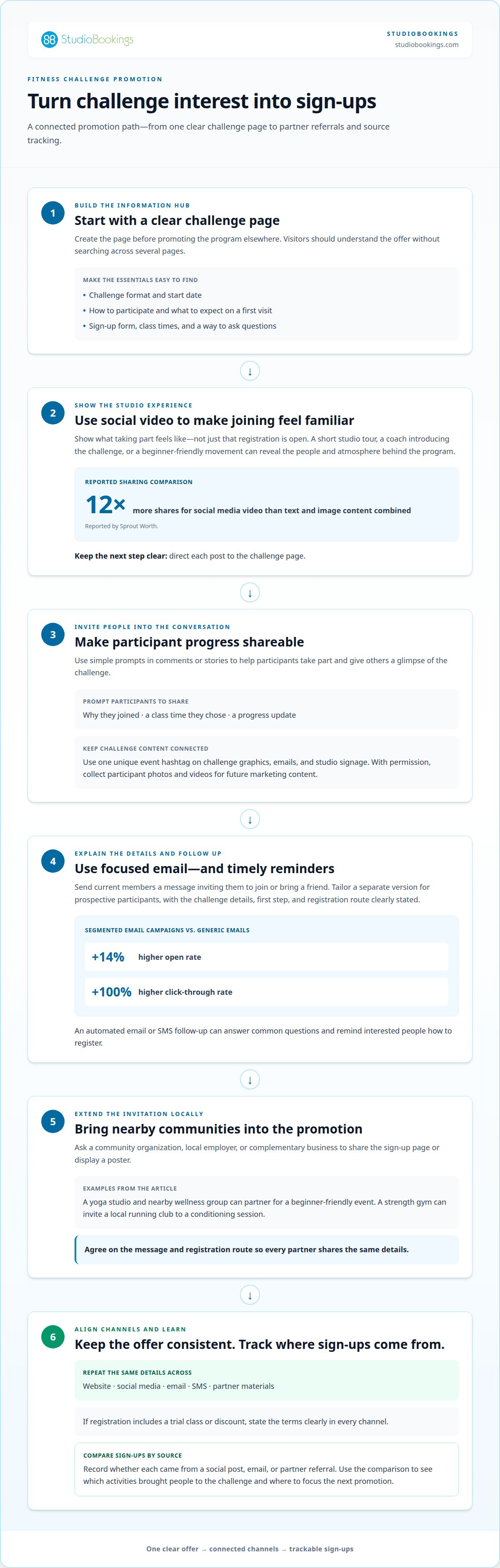
Create a clear challenge page on your website before promoting the program elsewhere. Explain the format, start date, how to participate, and what newcomers can expect on their first visit. Add a sign-up form and a direct call to action, such as “Join the challenge” or “Book your first class.” Visitors should be able to understand the offer without searching several pages. Include practical details such as class times and how participants can ask questions.
Use social media to show what joining feels like, not just announce registration. Post a short studio tour, a coach introducing the challenge, or a participant demonstrating a beginner-friendly movement. Video gives prospective members a glimpse of the people and atmosphere behind the program. Sprout Worth reports that social media video generates 12 times more shares than text and image content combined. Pair each post with one next step, such as signing up through the challenge page.
Invite participants to respond to simple prompts in a comment or story. Ask them to share why they joined, choose a class time, or post a progress update. Create a unique event hashtag and use it on challenge graphics, emails, and studio signage. A consistent tag makes participant posts easier to find and share. With permission, your team can also collect photos and videos for future marketing content.
Email helps you explain the details beyond a social post’s short caption. Send a message to current members asking them to join or invite a friend, then tailor another version for prospective participants. Segmented email campaigns have a 14% higher open rate and a 100% higher click-through rate than generic emails. Keep each message focused: describe the challenge, explain the first step, and link to registration. Use an automated email or SMS follow-up to answer common questions and remind interested people how to sign up.
Local partnerships can introduce your challenge to people who already gather nearby. Ask a community organization, local employer, or complementary business to share the sign-up page or display a poster. A yoga studio might partner with a nearby wellness group for a beginner-friendly event, while a strength gym could invite a local running club to a conditioning session. Agree on the message and registration route so every partner shares the same details.
Keep the offer consistent across your website, social media, email, SMS, and partner materials. If registration includes a trial class or discount, state the terms clearly in every channel. Track sign-ups by source, such as a social post, email, or partner referral. This comparison shows which activities brought people to the challenge and where to focus your next promotion.
Set an easy-to-understand goal and choose one consistent way to record progress. A step-count competition, for example, can compare weekly totals, while a strength challenge can track repetitions of a chosen exercise. Review progress using attendance records, participant logs, or check-ins, and explain the scoring before the competition begins.
Make the goal realistic for the format, class schedule, and abilities of the people you want to include. A step challenge might reward consistent participation rather than only the highest total. A strength competition could recognize personal progress as well as top results. This keeps the focus on engagement and lets newcomers take part without needing to outperform experienced members.
For a step-count competition, decide whether participants submit daily totals or a weekly sum. Explain how to record steps and when entries are due. A shared tracker or regular check-in can keep the process clear. If participants have different routines, include team goals alongside individual recognition. Teams build shared accountability, while individual categories let people track their own progress.
Strength competitions need a defined task and scoring rule. Participants might log repetitions of a selected movement or track how consistently they attend strength classes. Avoid combining different exercises or judging methods on one leaderboard. Publish the measure in advance, explain how to submit results, and recognize improvements as well as top scores. Clear rules make the competition easier to follow and give more people a reason to stay involved.
A broader fitness competition can combine class attendance, workout completion, and team participation. Keep the scoring simple, such as awarding credit for attending a scheduled class or contributing to a group target. Share weekly progress updates to celebrate effort, answer questions, and remind participants about upcoming sessions. Recognition might include a shout-out, a completion certificate, or an opportunity to lead a group warm-up.
Competition can support retention when participants feel noticed beyond the final result. With permission, share progress updates, celebrate milestones, and check in with people whose participation has paused. A friendly personal message can help them reconnect without making the challenge feel like a test. Challenges also give prospective members a structured reason to visit and experience your community, while current members build connections around shared goals.
Before launch, write down the goal, scoring method, submission process, and recognition plan. Explain the rules in the welcome message and repeat them during the challenge. Clear expectations reduce confusion, keep progress comparable, and help participants understand what success looks like.
Choose a format that connects the challenge goal to a clear action. Popular options include weight-loss programs, group workouts, step-count contests, strength competitions, and seasonal programs. Each works best when participants know what counts as progress and how to record it. A group-training studio might focus on class attendance, while a seasonal program could use themed workouts to keep sessions varied.
A challenge can run for 30 days, giving participants a defined start and finish. One example asks members to attend at least 10 classes within a 30-day period. For a longer program, six-week and twelve-week fitness challenges starting in January are options. Match the duration to the goal: a short program can suit a specific attendance target, while a longer format allows time to build a consistent routine.
Keep the main activity simple. In a mindfulness program, participants might complete a meditation session each day. For a group workout challenge, set a recurring class goal and use attendance to track completion. Seasonal themes can give the program a recognizable identity, such as a spring movement challenge or winter strength series. Choose one central action so participants don’t have to decode complicated rules.
Use progress markers that participants can see and understand. A calendar can show completed classes, while a shared tracker can record daily activities. Set milestones at the beginning, midpoint, and finish, and recognize effort at each stage. Completing a first class, for example, gives participants an early win on the way to the overall goal. Keep the focus on steady action, not only the final result.
Write eligibility and participation rules before registration opens. State who can join, which activities count, how progress is recorded, and how recognition is decided. A waiver or participation acknowledgment should clearly explain the activity, participant responsibilities, and relevant risks. It does not replace safe instruction or supervision.
Support safe participation by offering appropriate exercise options, explaining equipment use, and making it easy to pause or modify a workout. Consider the movements, intensity, equipment, and participants’ experience when planning supervision and emergency procedures. Clear instructions and a defined way to report discomfort help participants take part responsibly.
Before launch, check that the format fits your studio schedule. Confirm that the required classes or activities run throughout the challenge, and make progress tracking practical for staff. A well-matched format gives newcomers a concrete first step and current members a shared reason to participate.
Choose an entry offer that makes participation easy and gives newcomers a clear next step. A free introductory session or access to a challenge class lets prospective members experience your coaching before considering membership. If the challenge has a fee, explain exactly what it includes and whether it applies toward joining. Match the offer to your audience and membership options rather than discounting without a plan to convert participants.
Running costs depend on staffing, rewards, promotional materials, and any extra event needs; set the budget after a quote request. To plan responsibly, list each cost before registration opens, then compare expected income with the resources required to run the program. A simple challenge built around regular classes may need fewer extras than a one-day event with guest contributors or participant prizes.
Make referrals part of the challenge experience, not a separate sales push. Invite each participant to bring a friend to a suitable class or share a registration link with someone interested in fitness. Nielsen data reports that 92% of consumers trust referrals from friends. Give members a clear way to identify their referral, such as a named signup field or a referral code, so staff can record who invited each newcomer.
A referral reward should be easy to understand and relevant to both people. You might offer a class benefit, membership discount, or special session when a referred friend joins, and reward both the new member and the person who referred them. State when the reward applies, who qualifies, and how participants receive it. Clear terms prevent confusion and make members more comfortable sharing the offer.
A time-limited referral offer gives participants a reason to act during the challenge. Set a closing date that matches the registration window, then share the same terms by email, on social media, and in studio materials. Keep the incentive consistent across platforms. This helps staff answer questions and makes it easier for newcomers to register.
Track the path from invitation to membership. Record challenge registrations, referral sources, class attendance, and membership sign-ups through one process. Review which channels brought participants who attended and which referrals led to sign-ups. If people register but don’t show up, improve reminders or make the first class easier to book. If referrals bring engaged participants, build on that approach in your next challenge.
Treat the challenge as a way to build long-term value, not just short-term revenue. A welcoming first class, a clear next step toward membership, and a relevant referral reward can work together. Decide on the offer, tracking method, and follow-up before promotion begins, so every participant knows what to do after completing the challenge.
Creating a fitness challenge to attract new members starts with one useful question: what should a participant’s next step feel like? Make that transition part of the experience, not an afterthought. A warm welcome, a personal conversation, or an invitation to try another class can help newcomers picture themselves as part of your studio.
After the challenge, learn from both the people who joined and those who didn’t continue. Their feedback can show what felt engaging, where instructions caused confusion, and what would make the next program more accessible. Use those insights to refine your approach and strengthen the connection between a first visit and regular participation.
When creating a fitness challenge to attract new members, you don’t need a perfect plan to make it valuable. Start with an achievable program, pay attention to the participant experience, and improve it as you learn. If you’re ready to discuss how StudioBookings can support your studio, contact StudioBookings. A welcoming first step can become the beginning of a lasting community.
Gyms can attract prospective members with challenges ranging from month-long weight-loss competitions to one-day lifting, yoga, or cardio events. This range offers different ways to invite people in: some may prefer a sustained competition, while others are drawn to a single event. Choose a format that suits the experience your gym wants to offer and gives prospective members a clear reason to participate. A one-day event and a longer competition are distinct options, not a single format every gym needs to adopt.
The page recommends that gyms and studios offer 6-week fitness challenges starting in January. It also recommends that gyms and studios offer 12-week fitness challenges starting in January. These recommendations provide two different durations to consider when shaping an offer for that time of year. A studio can decide which duration best fits the challenge it wants to present, and make the length clear to people considering participation. The important point is to give prospective members a defined challenge to consider, rather than relying on a general invitation to visit.
Gyms can host fitness challenges to help create camaraderie and give potential members a reason to join. That makes the challenge more than an activity: it can also serve as a shared reason for people to take part and connect with the gym. LIFT Lounge’s transformation challenge runs for 8 weeks and includes $100,000 in prizes. Its stated duration and prizes show one way a challenge can be presented with concrete details. Whatever format a gym chooses, describing the challenge clearly can help prospective members understand what is being offered and decide whether it is an invitation they want to accept. The range of possible formats leaves room to create an offer suited to the gym, from a one-day event to a longer competition.
StudioBookings helps fitness and HIIT studios manage challenge operations alongside regular classes. Use the software to schedule sessions, handle memberships and payments, and manage staff from one dashboard. This helps keep challenge bookings and member administration organized as participants move from a trial session to ongoing classes. StudioBookings also provides software for yoga, Pilates, barre, pole, and dance studios. Explore how StudioBookings can support your studio’s day-to-day operations and help you welcome challenge participants into their next class.
A thoughtful fitness challenge to attract new members begins with one useful question: what should a participant’s next step feel like? Make that transition part of the experience, not an afterthought. A warm welcome, a personal conversation, or an invitation to try another class can help newcomers picture themselves as part of your studio.
After the challenge, learn from both the people who joined and those who didn’t continue. Their feedback can show what felt engaging, where instructions caused confusion, and what would make the next program more accessible. Use those insights to refine your approach and strengthen the connection between a first visit and regular participation.
Your next challenge doesn’t need to be perfect to be valuable. Start with an achievable plan, pay attention to the participant experience, and improve it as you learn. If you’re ready to discuss how StudioBookings can support your studio, contact StudioBookings. A welcoming first step can become the beginning of a lasting community.
Challenges with clear, welcoming activities can appeal to people who are new to structured exercise. Try a consistency challenge that recognizes participants for showing up, or a team-based program where newcomers can join an existing group. A mindfulness challenge can introduce people to a quieter studio offering. Choose an idea that reflects your classes and gives first-timers a comfortable way to participate.
Give each promotion route a clear registration method so you can track responses. For example, add a QR code to a flyer at a community noticeboard and use a distinct sign-up link in an online post. Ask local partners to share the same challenge details and direct people to the registration page. After sign-up, send participants the location, schedule, and what to expect at their first session.
Choose rewards that recognize progress, not only the top performer. A completion certificate, member spotlight, or chance to choose a future class theme can motivate participants with different starting points. If you offer a guest pass or class benefit, explain who qualifies and when it can be used. Clear, attainable rewards make the challenge welcoming and give participants a reason to finish.


