
The busiest hours shouldn’t dictate your whole class schedule. Aim for 10-20 group fitness classes per week, adjusting the number to your member base. Learning how to fill off-peak fitness classes starts with matching the time, coach, and workout to the people who can attend then.It’s frustrating wh...

The busiest hours shouldn’t dictate your whole class schedule. Aim for 10-20 group fitness classes per week, adjusting the number to your member base. Learning how to fill off-peak fitness classes starts with matching the time, coach, and workout to the people who can attend then.
It’s frustrating when peak-time sessions fill up but another class stays quiet. A low-attendance slot doesn’t always need to disappear. A different start time, more suitable format, or instructor who connects with that audience may make it a better fit.
This guide explains how to review attendance, test schedule changes, and choose programming for quieter hours. You’ll also learn how often to schedule group classes and when to adjust or reconsider a session. The goal is a timetable based on real member habits, not guesswork or a smaller copy of your peak schedule.
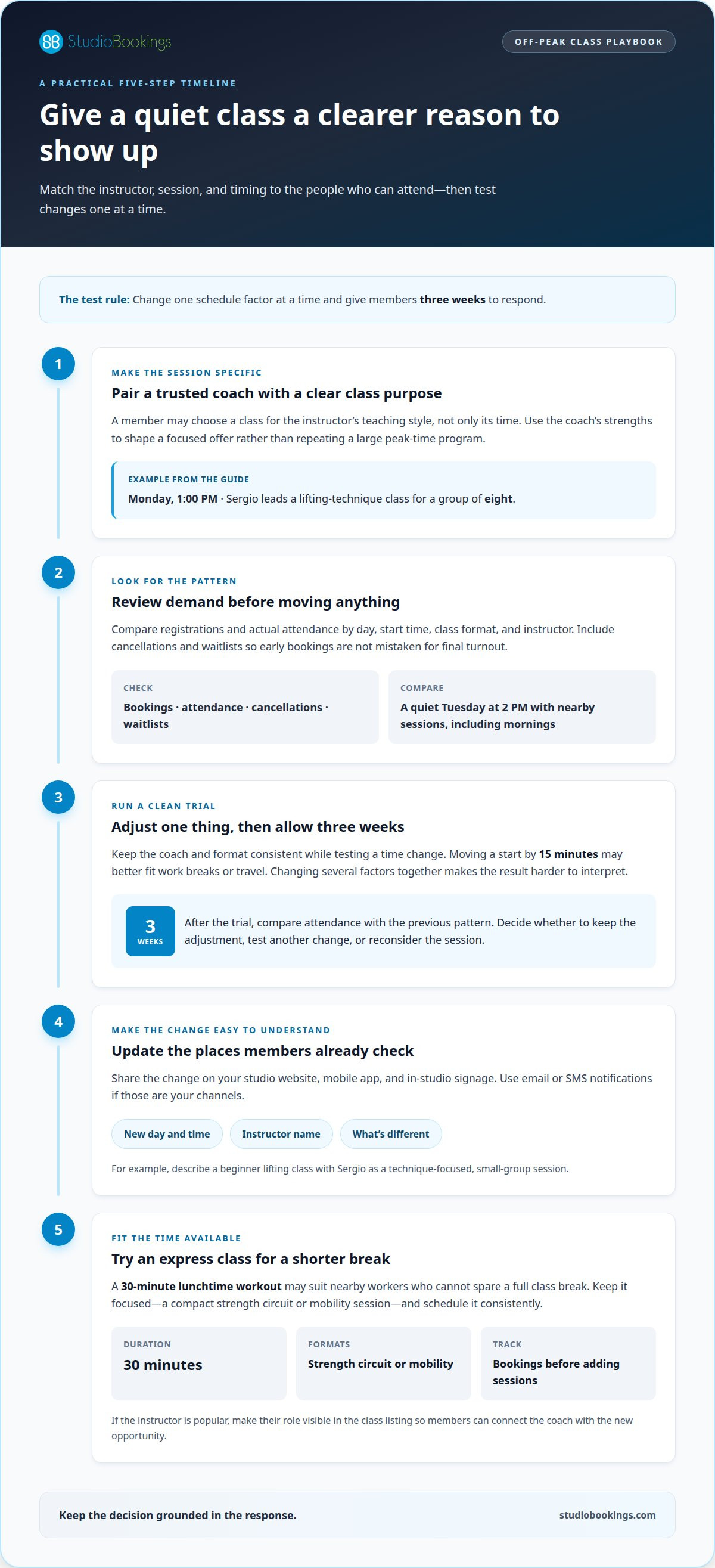
• Test a low-attendance class with one change at a time, such as moving it by 15 minutes or assigning a popular coach, then review the response over three weeks.
• Before cutting a quiet session, try a new format or instructor and ask members what would make the class easier to attend.
• Give off-peak sessions a clear draw, such as skill-focused micro-sessions or double loyalty stamps.
• Match class times and partnerships to the routines of nearby workers, students, and local businesses instead of relying only on peak-hour habits.
• Use class scheduling and attendance records to spot patterns and make more informed timetable changes.
• Put a trusted instructor in a quieter session and make the class offer specific. Members may choose a class because they value the coach’s teaching style, not just its time. Try a skill-focused format that suits the instructor’s strengths. For example, a Monday 1:00 PM class can focus on lifting technique with Sergio and serve a group of eight. That gives the session a clear purpose and a more personal feel than repeating a large peak-time program.
• Use scheduling and booking technology to spot patterns before changing the timetable. Compare registrations and attendance by day, start time, class format, and instructor. A Tuesday 2 PM session may be quiet, while a nearby morning class attracts a different audience. Look at cancellations and waitlists too, so early bookings don’t get mistaken for final attendance. A simple record for each session helps you see whether the coach, timing, or program may be affecting turnout.
• Test one schedule change at a time, then give members three weeks to respond. If you move a Tuesday 2 PM class, keep its coach and format consistent during that trial. Another option is shifting the start time by 15 minutes to better fit work breaks or travel. Changing several factors together makes the result harder to interpret. After three weeks, compare attendance with the previous pattern and decide whether to keep the adjustment, test another change, or reconsider the session.
• Tell members about a schedule change wherever they already look for class details. Update your studio website, mobile app, and in-studio signage, then send email or SMS notifications if you use those channels. Clearly state the new day and time, name the instructor, and explain what’s different about the session. For a beginner lifting class with Sergio, for example, highlight the focus on technique and the small-group format. Clear details help members decide whether the new slot suits them.
• Offer an express class when a shorter session fits the audience better. A 30-minute lunchtime workout can suit people working nearby who can’t spare a full class break. Keep the format focused, such as a compact strength circuit or mobility session, and schedule it at a consistent time. Use bookings to track interest before adding more sessions. If the instructor is popular, make their role visible in the class listing so members can connect the coach with this new opportunity.
Before changing a class or its offer, use attendance patterns to pinpoint the problem. A focused test can reveal whether members need a different time, incentive, or local connection.
•
Review each class’s bookings, cancellations, and actual attendance over three weeks. Compare the same session across days and times, and note whether members who attend at peak hours also skip quieter slots. Look for repeat bookings and waitlists, not just one unusually busy or quiet day. Use the data to identify when interest appears and which formats bring members back before offering trial times in quiet slots.
•
Offer double stamps for each off-peak class to give members a clear reason to try a quieter session. Explain which classes qualify and how to earn stamps when booking, so the incentive feels simple and consistent. After launching it, track attendance and compare repeat visits with the earlier pattern. Tie the reward to off-peak visits, not peak hours, to support the schedule you want to strengthen.
•
Invite nearby employers, schools, and local businesses to share a class opportunity with their communities. A lunchtime express session may suit nearby staff, while an after-school class could work for families or school employees. Give partners a simple booking path and a class description they can pass along. Track bookings by partner or referral source, then focus on relationships that connect new members with sessions they can attend regularly.
•
Test a promotion on selected off-peak sessions before applying it across your schedule. A broad discount may shift existing bookings from peak classes without bringing in additional attendance, reducing revenue instead of filling empty capacity. Changing the time, instructor, and format together also makes results hard to interpret. Explain the change clearly, then review attendance and feedback before deciding whether to keep, adjust, or stop the offer.
• Set off-peak pricing to reward flexibility without undercutting peak sessions. A limited off-peak membership can restrict visits to quieter hours, while a class-specific promotion can target one session. Make eligibility and booking conditions clear, and compare results with regular attendance before expanding the offer.
• Measure promotion cost-effectiveness by comparing off-peak revenue with revenue from an otherwise empty slot. Record later member upgrades separately, and count new trial inquiries, booked trials, and trials that become paid plans each night. Class booking tools can help keep registrations and attendance organized for review.
Successful gyms match off-peak workouts to local routines, interests, and available time. Use registration patterns and member feedback to shape the schedule, then test a focused program before expanding it.
• Identify who can attend each quieter session and what they need from a workout. Nearby office workers may prefer a short, efficient class, while residents with flexible schedules may choose a longer technique session. Ask members about their preferred intensity and class formats. Their answers can help distinguish a genuine local opportunity from a time slot that simply needs clearer programming.
• Build a short, skill-focused session around one outcome. A 20- to 30-minute micro-session can teach a movement pattern, introduce strength basics, or focus on mobility. Keep the goal specific, so members know what they’ll practice before booking. A concise format also gives people with limited time a practical reason to try an off-peak class.
• Choose the intensity and equipment to suit the audience, rather than defaulting to the instructor’s usual peak-time routine. For example, a cardio session can use simple intervals and offer lower-impact options for beginners. A strength class can focus on form instead of fast transitions. Clear descriptions help members choose a suitable workout and know what to expect.
• Use a longer format only when the content justifies the time. An hour-long bootcamp can combine strength, cardio, and recovery, but it needs a clear progression. Break the class into distinct blocks and explain how each contributes to the workout. If attendance stays low, consider whether the duration, intensity, or format conflicts with the local audience’s routine.
• Make the class schedule easy to understand across different local markets. A commuter neighborhood may respond to sessions before or after work, while a residential area may show more interest during daytime hours. Treat these as starting points, not assumptions. Compare booking patterns for each location and adjust the class description, start time, or program to reflect what members actually choose.
• Test one programming change at a time and record its effect on attendance. For example, keep the time fixed while replacing a general workout with a beginner technique session. Note bookings, attendance, and member comments. If interest improves, keep the format and refine the details. If it doesn’t, test another clear adjustment instead of changing everything at once.
• Involve instructors in shaping the experience without making the class depend on personality alone. Ask them to explain the session’s goal, offer practical options, and give first-time attendees a consistent welcome. A repeatable structure helps members know what to expect, while an instructor’s energy can make the program feel personal and engaging.
• Map class times against the routines around your studio. Attendance is typically busiest between 5 PM and 8 PM, while Wednesday at 11 AM is one example of a quieter slot. Treat these as planning clues, not fixed rules for every neighborhood. A practical way to decide how to fill off-peak fitness classes is to compare booking patterns with the routines of members near your location.
• Offer a morning session for members who exercise before work. Pitt Group Fitness schedules Ride RACE on Mondays from 7:30 to 8:30 A.M. during Fall 2026, showing how cycling can anchor an early timetable. A strength class may suit a different audience. Give each offering a clear reason to attend, such as focused training before the workday.
• Build a daytime option around a specific local opportunity. Pitt Group Fitness schedules Ride READY on Fridays from 10:00 to 11:00 A.M. during Fall 2026. A studio can use a similar daytime slot to serve members with flexible schedules. Make the class description direct, so members can see how that exercise session differs from evening programming.
• Use the late afternoon to create a bridge between daytime and peak hours. Pitt Group Fitness schedules Panther Pump on Thursdays from 4:15 to 5:15 P.M. during Fall 2026. A strength-focused class before the 5 PM to 8 PM rush can offer members another workable start time. Keep the instructor and format consistent while tracking bookings and attendance.
• Use seasonal demand as a reason to review the full class schedule. Fitness facilities commonly see greater crowds from January through March, and another busy period from September through October. Before those stretches, identify sessions for members seeking alternatives to crowded peak hours. Afterward, compare attendance and adjust times based on your studio’s own records.
• If your facility operates around the clock, spread classes across different parts of the day. A timetable limited to early mornings and evenings overlooks members available between those periods. Add a daytime option and make its format and start time clear. One trial session can show whether that time deserves a regular place.
• Change the class schedule in a way that gives members a clear reason to try a new time. To understand how to fill off-peak fitness classes at your studio, make one adjustment and track its response. Announce the day, start time, instructor, and workout focus together. For example, promote a Thursday 4:15 PM strength session as an alternative before evening peak hours. Review bookings after the change, and encourage members to share which times fit their routines.
• Start with nearby organizations whose daily routines match a quiet class time. An office close to the studio may have employees available at lunch, while a school may suit early-afternoon sessions. Choose one class that fits the group’s schedule rather than proposing the entire timetable. A clear match makes the partnership useful for the organization and its people.
• Offer employers a straightforward group option tied to a specific session. For example, invite a nearby workplace to try a lunchtime strength class and provide a booking link employees can share internally. State the class length, start time, intensity, and experience level in the invitation. These details help staff quickly decide whether the workout fits their break and fitness needs.
• Shape school partnerships around who can attend, rather than relying on a broad label. School employees may prefer a session before classes or after dismissal, while older students may need a different format and timetable. Propose one suitable class first, such as beginner dance fitness after the school day. Coordinate the invitation through an appropriate school contact, and make participation voluntary and expectations clear.
• Give local businesses an easy way to introduce the studio to their customers or staff. A nearby café could share a notice about a daytime Pilates session, while a retailer might tell employees about an early-evening class. Keep the message specific to one session and include a direct booking path. Avoid asking partners to promote several offers at once, which can obscure the opportunity.
• Make the first visit easy to understand and book. Provide a short class description, location details, what to bring, and booking instructions in one message partners can share. For a local employer, name the lunchtime session and explain whether beginners can join. A clear introduction reduces uncertainty and gives first-time attendees a practical route from referral to reservation.
• Track partner referrals separately from regular bookings. Record which organization shared the invitation, which session people booked, and whether they attended. If a school referral brings interest in an afternoon class but few arrivals, ask whether the time or format created friction. Use the feedback to revise the offer before repeating it. Assess each partnership by attendance and repeat visits, not impressions alone.
• Keep communication active after the first class. Send the partner a concise update about the session’s next date and any useful changes, then invite them to share it again. For instance, a workplace can circulate a new lunchtime class schedule when staff request another option. Streamline studio class bookings as you turn local referrals into reservations.
StudioBookings helps fitness studios manage schedules, bookings, memberships, payments, and staff from one dashboard. When you’re testing off-peak times or formats, bringing these essentials together can make timetable updates and class administration easier.
StudioBookings’ Fitness and HIIT Studio Software supports the day-to-day operations behind your group program. The platform also includes a mobile app for studio owners and members, so members can use studio services on mobile. It’s a practical next step when schedule changes and bookings are becoming difficult to coordinate across separate tools.
Explore StudioBookings if you want a central place to manage your studio’s classes and operations. Contact StudioBookings to discuss whether its software fits your studio.
A quieter class slot can become a useful part of your studio’s program when you treat it as a chance to learn. Start with one deliberate change, then use member responses to guide what comes next. That’s a practical way to approach how to fill off-peak fitness classes without relying on guesswork. Over time, each test can help you build a timetable that suits the people you serve and gives them more ways to take part.
StudioBookings offers Fitness and HIIT Studio Software, Yoga Studio Software, and Pilates and Barre Studio Software. Its platform helps studios manage class schedules, bookings, memberships, payments, and staff from one dashboard. If you’re ready to bring those studio operations together, contact StudioBookings to discuss your class schedule.
Your next off-peak session is an opportunity to learn what members value. Make a thoughtful change, listen to their response, and keep building a schedule that works for your community.
Aim for 10-20 group fitness classes per week, adjusting the total to your member base. Build a timetable around the formats and time slots people use, rather than filling every available hour. Review it at least every quarter. If existing classes regularly fill, consider adding sessions to spread demand or ease waitlist pressure. A smaller, well-used schedule is more useful than one with quiet classes scattered throughout the week.
Start with booking and attendance patterns, then ask prospective members what they prefer. A simple question about morning, afternoon, or evening workouts can reveal demand your current timetable misses. Compare responses with actual bookings, since stated preferences may not translate into attendance. For example, if leads request afternoons but rarely reserve those classes, test a different format or start time before adding sessions.
Use quiet afternoons for focused coaching rather than leaving the time without a clear purpose. An instructor could lead a technique session, offer a beginner-friendly workout, or help participants build confidence with equipment. Keep the session’s goal specific so members understand its value. A small-group format can also allow more individual guidance than a large class designed for peak attendance.
Focus on people whose daily routines give them flexibility in the afternoon. They may include remote workers, shift workers, local business employees, students with open periods, or people working nearby. Match the class format to the group: a short lunchtime workout may suit office staff, while a daytime mobility class could appeal to members with more flexible schedules. Ask leads about their availability rather than making assumptions.
Give each quieter class a distinct reason to attend. A technique session, express workout, or themed class can feel more purposeful than a duplicate of the evening program. Explain in the class description who it suits and what members will practice. Ask instructors to welcome newcomers and describe the options during class. These details can make a first visit feel approachable and give attendees a reason to book again.
Compare bookings, attendance, cancellations, and repeat visits by time and class type. Pair the records with direct feedback from members and prospective attendees. For example, offer a choice between a morning strength session and an afternoon mobility class, then see which gets booked and attended. Don’t rely on a single busy day or a handful of early reservations. Consistent patterns provide a stronger basis for schedule decisions.
Try a time-specific incentive, such as double loyalty stamps for attending an off-peak class. A limited promotion tied to one session can also show whether the offer changes bookings. Keep the terms clear, and track whether attendance comes from new visits or members shifting from peak classes. Compare the additional revenue with what the otherwise empty slot would have earned, so the promotion supports demand rather than simply lowering the value of existing bookings.
Explain the session’s practical value, then share its details where your audience already looks for class information. Describe the format, instructor, level, and time, and make the booking route easy to follow. For current members, show how the class suits a different routine or training goal. For prospective members, provide a clear introduction that sets expectations and helps them decide whether the workout fits their experience.